

Changing certification providers can feel like starting over.
You already have certification reports. You already have test data. Your facility may already have a history of factory inspections and surveillance.
So why automatically rebuild the process from the beginning?
A certification file transfer may give manufacturers another path.
Instead of treating an existing certification as a brand-new project, a file transfer allows the existing technical documentation and certification history to be reviewed as part of the transition.
For manufacturers considering a move to LabTest, here’s what that process can look like.
Why Consider a Certification File Transfer?
1. Build on the work you’ve already completed
Certification represents significant time, testing, documentation and engineering work.
With a file transfer, manufacturers provide their existing certification or listing reports, available test data and previous factory inspection records for review.
LabTest then evaluates the technical information to determine whether it is valid and addresses the requirements of the applicable standards.
The goal isn’t to assume everything needs to be done again. It’s to understand what you already have and determine what is needed for the transfer.
2. Your factory inspection history can work in your favour
Factory inspections are an important part of ongoing certification for many manufacturers.
But if you already have valid factory inspection records from the previous 12 months, there may be an opportunity to avoid an Initial Factory Inspection when transferring the file to LabTest.
That means your existing factory surveillance history isn’t simply background information, it can be an important part of the transfer review.
Valid inspection records from the previous 12 months → Initial Factory Inspection may be waived.
3. Keep the transition moving
Once the required technical documentation has been provided and reviewed, the next steps are straightforward.
The client signs the Certification Listing Agreement, and LabTest proceeds with the file transfer.
When all required technical documents are available, the transfer can be completed within 10 business days.
That can help manufacturers transition their certification without creating an unnecessarily long process.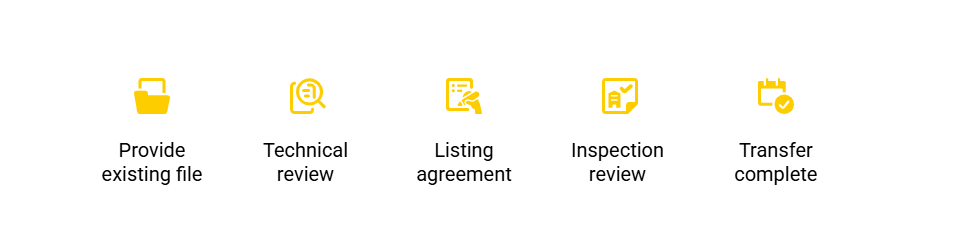
So, What Does the File Transfer Process Look Like?
The process can be broken down into five key steps:
01 — PROVIDE YOUR EXISTING FILE
Submit your current certification/listing reports, available test data and previous factory inspection records.
02 — TECHNICAL REVIEW
LabTest reviews the technical information to verify its validity and assess it against the requirements of the applicable standards.
03 — CERTIFICATION LISTING AGREEMENT
Once the file has been reviewed, the client signs the Certification Listing Agreement.
04 — FACTORY INSPECTION REVIEW
If valid factory inspection records from the previous 12 months are available, the Initial Factory Inspection may be waived.
05 — TRANSFER COMPLETE
With all required technical documentation available, the transfer can be completed within 10 business days.
Is File Transfer Only for NRTL Certification?
No.
While NRTL certification is an important part of the process, file transfers can apply across different certification programs and services.
Depending on the certification and applicable requirements, examples can include:
NRTL | ATEX | IECEx | LC Mark
File transfers can also be relevant to manufacturers with established factory surveillance relationships, including situations involving management system certifications such as ISO 9001.
The specific requirements will depend on the certification, existing documentation and applicable standards.
What Should You Have Ready?
If you’re considering transferring an existing certification file, having the right documentation available can help get the review underway.
Start with:
- Current certification or listing reports
- Available test data
- Previous factory inspection/surveillance records
- Documentation identifying the applicable standards and certification scope
The more complete the technical file, the more efficiently the transfer can be assessed.
The Bottom Line
A change in certification provider doesn’t necessarily mean throwing away the technical work and certification history you’ve already built.
A file transfer gives manufacturers the opportunity to have that existing information reviewed and determine what can be carried forward.
And with LabTest, the process can extend across certification programs including NRTL, ATEX, IECEx and LC Mark, depending on the applicable requirements.