

Quality is rarely lost in one dramatic failure. More often, it erodes through small inconsistencies that go unnoticed until they affect a customer, a delivery, or the bottom line.
A process is followed differently by two employees. A supplier change introduces unexpected variation. A recurring customer complaint is resolved, but its underlying cause remains. Documentation exists, yet the people responsible for using it aren’t working from the same information.
Individually, these issues may appear manageable. Over time, however, they can expose weaknesses in how an organization operates.
This is where a quality management system (QMS) becomes more than a collection of procedures. It provides a structured way to understand how work is performed, evaluate whether processes are achieving their intended results, and identify opportunities for improvement.
ISO 9001 provides an internationally recognized framework for doing exactly that.
But understanding what the standard requires and how to apply it effectively is what separates a certificate on the wall from a management system that delivers value.
What ISO 9001 Actually Evaluates
ISO 9001 specifies requirements for a quality management system. It applies to organizations across industries and of different sizes, whether they manufacture physical products or provide services.
Rather than prescribing one universal way to run a business, it establishes a framework organizations can adapt to their activities, customers, and operational context.
The focus extends beyond final inspection or checking whether a product meets specifications. It considers the processes, responsibilities, resources, and controls that influence an organization’s ability to consistently meet customer and applicable regulatory requirements.
Key areas include:
- Leadership and accountability: Establishing quality objectives, defining responsibilities, and ensuring management actively supports the system.
- Process control: Understanding how activities connect, where variation can occur, and what controls are needed to achieve consistent outcomes.
- Risk-based thinking: Identifying factors that could prevent intended results and taking appropriate action.
- Competence and documented information: Ensuring people have the necessary knowledge and that relevant procedures, records, and instructions are maintained.
- Performance evaluation: Monitoring results, reviewing relevant data, and assessing whether processes are working as intended.
- Continual improvement: Using evidence, audit findings, customer feedback, and corrective actions to strengthen the system over time.
Together, these elements help organizations manage quality as an integrated business function rather than an isolated responsibility assigned to one department.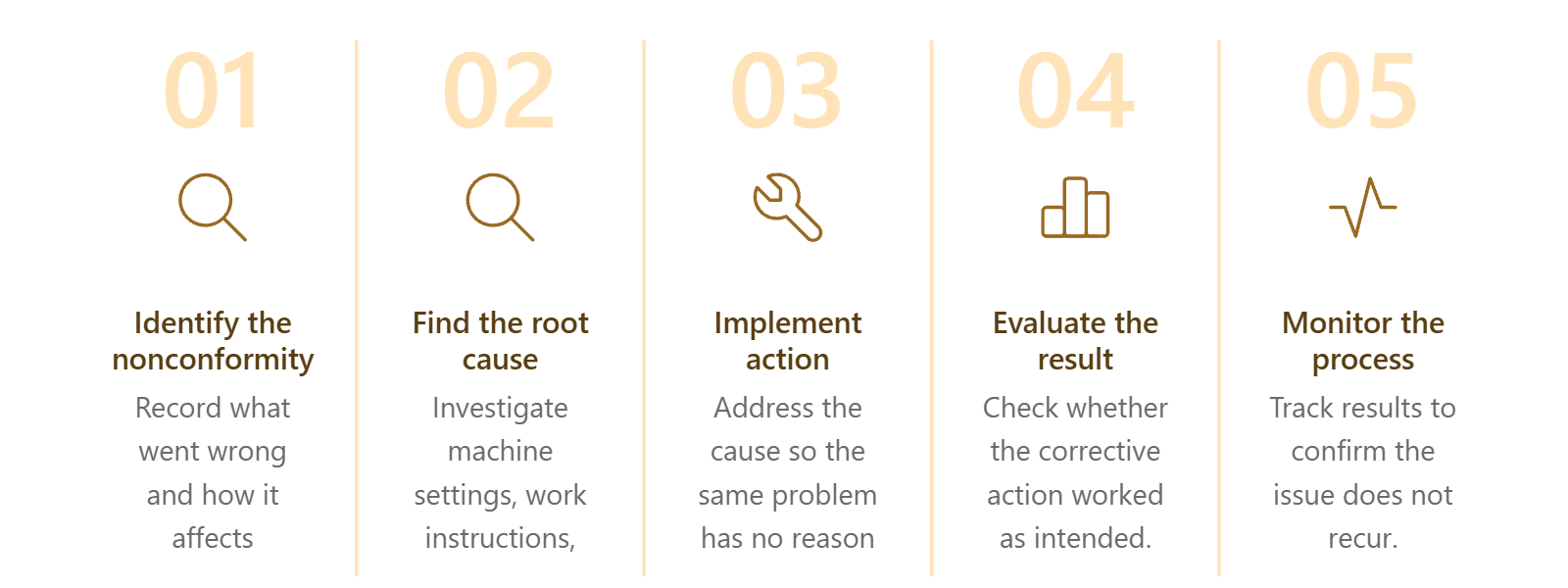
The Difference Between Having Procedures and Controlling Processes
A documented procedure does not automatically mean a process is effective.
Consider a manufacturer experiencing recurring defects in one product line. The inspection team identifies nonconforming units, records the findings, and prevents those units from moving forward.
That is an important control but it may not resolve the underlying problem.
If the defects originate from inconsistent machine settings, unclear work instructions, inadequate training, or variation in incoming materials, inspecting the finished product will not eliminate the cause.
A functioning QMS encourages a more systematic response:
- Identify the nonconformity and understand its impact.
- Investigate the underlying cause rather than simply correcting the immediate
- problem.
Implement appropriate corrective action. - Evaluate whether the action was effective.
- Monitor the process to determine whether the issue recurs.
The same principle applies to customer complaints, missed delivery commitments, supplier performance, and repeated administrative errors.
The objective is not merely to document problems. It is to use evidence to understand why they occur and improve the processes responsible for them.
What ISO 9001 Certification Does and Does Not Mean
ISO 9001 certification is frequently misunderstood, particularly when it comes to product quality.
ISO 9001 certifies an organization’s quality management system, not every individual product it manufactures.
A certified organization has undergone an assessment of its management system against the applicable requirements of the standard. This provides evidence that the system has been evaluated against an established framework for quality management.
It does not mean that every product is defect-free, that every customer will be satisfied, or that every operational risk has been eliminated.
Product conformity and management system conformity address different questions.
Product testing and certification assess a product against applicable requirements for its intended market or application. ISO 9001, by contrast, focuses on the organizational processes used to manage and improve quality.
Depending on the business, both may play important and complementary roles.
Certification should therefore be understood as evidence of conformity to a defined management system standard not a guarantee of perfect outcomes.
Where the Business Benefits Actually Come From
The value of a quality management system depends on how effectively it is implemented and maintained.
When processes are clearly defined, responsibilities are understood, and performance is evaluated using meaningful information, organizations can identify inefficiencies that might otherwise remain hidden.
Potential benefits include:
- Greater consistency: Standardized processes help reduce avoidable variation in how work is performed.
- Better-informed decisions: Performance data, audit findings, and customer feedback provide a stronger basis for deciding where improvements are needed.
- More effective corrective action: Investigating root causes helps organizations address recurring problems rather than repeatedly managing the same symptoms.
- Improved customer confidence: A structured approach to meeting requirements and addressing feedback demonstrates a commitment to managing quality.
- Operational efficiency: Identifying duplicated activities, unclear responsibilities, and process weaknesses can help reduce waste and unnecessary costs.
- Stronger supplier and customer relationships: Defined expectations and more consistent processes can improve coordination across the supply chain.
These outcomes are not automatic consequences of obtaining a certificate. They depend on management commitment, employee involvement, appropriate implementation, and the continued use of the system.
A QMS that exists primarily to satisfy an audit may create administrative work without delivering its full potential. One that informs everyday decisions can become a practical management tool.
Making ISO 9001 Work in Practice
Implementing a quality management system requires more than preparing documentation for an audit. It involves understanding how the organization operates and determining how the standard’s requirements can be applied effectively.
For some organizations, the starting point is establishing a system for the first time. Others may already have documented procedures but need to improve process ownership, internal auditing, corrective action, or management review.
A structured approach can help organizations understand their current position, identify gaps, and plan the work needed to establish or strengthen their system.
Internal audits are particularly important in this process. When conducted effectively, they provide insight into whether established processes are being followed and whether the system is achieving its intended outcomes.
Management reviews, performance monitoring, and corrective actions then help turn those findings into decisions and improvements.
The most effective systems are those that remain relevant to the organization—not simply those that produce the most documentation.
How LabTest Certification Supports Management Systems
LabTest Certification provides management systems training, assessment, and certification services in accordance with the ISO 9000 series of standards.
Our services include:
- Initial assessment
- Documentation training for management and executive teams
- Case-by-case training to support system development and implementation
- Internal audit training and review of internal audit processes
- Recommendations on certification to international standards
Final audit and certification
This support helps organizations understand the requirements, assess their existing processes, and work toward establishing a management system suited to their business.
For organizations pursuing ISO 9001 certification or looking to strengthen an existing quality management system, the starting point is understanding the requirements that apply and developing a practical plan to address them.
To learn more about LabTest Certification’s management systems services, visit:
Takeaway
Quality management is not defined by how many procedures an organization maintains or how successfully it prepares for an audit.
It is reflected in how consistently people perform their work, how effectively problems are addressed, and how well the organization learns from its results.
ISO 9001 provides a framework for bringing those activities together into a system that can be evaluated, maintained, and continually improved.
The certificate may demonstrate conformity. The real value lies in how the system works long after the audit is over.