

When a plumbing fixture fails in the field, the failure is rarely sudden.
It is usually the result of internal components that have been degrading over time, long before the first visible symptom appears.
That’s because plumbing products are not only exposed to extreme conditions such as temperature variations and pressure changes.
They are also subjected to repeated use over time.
What Actually Carries the System
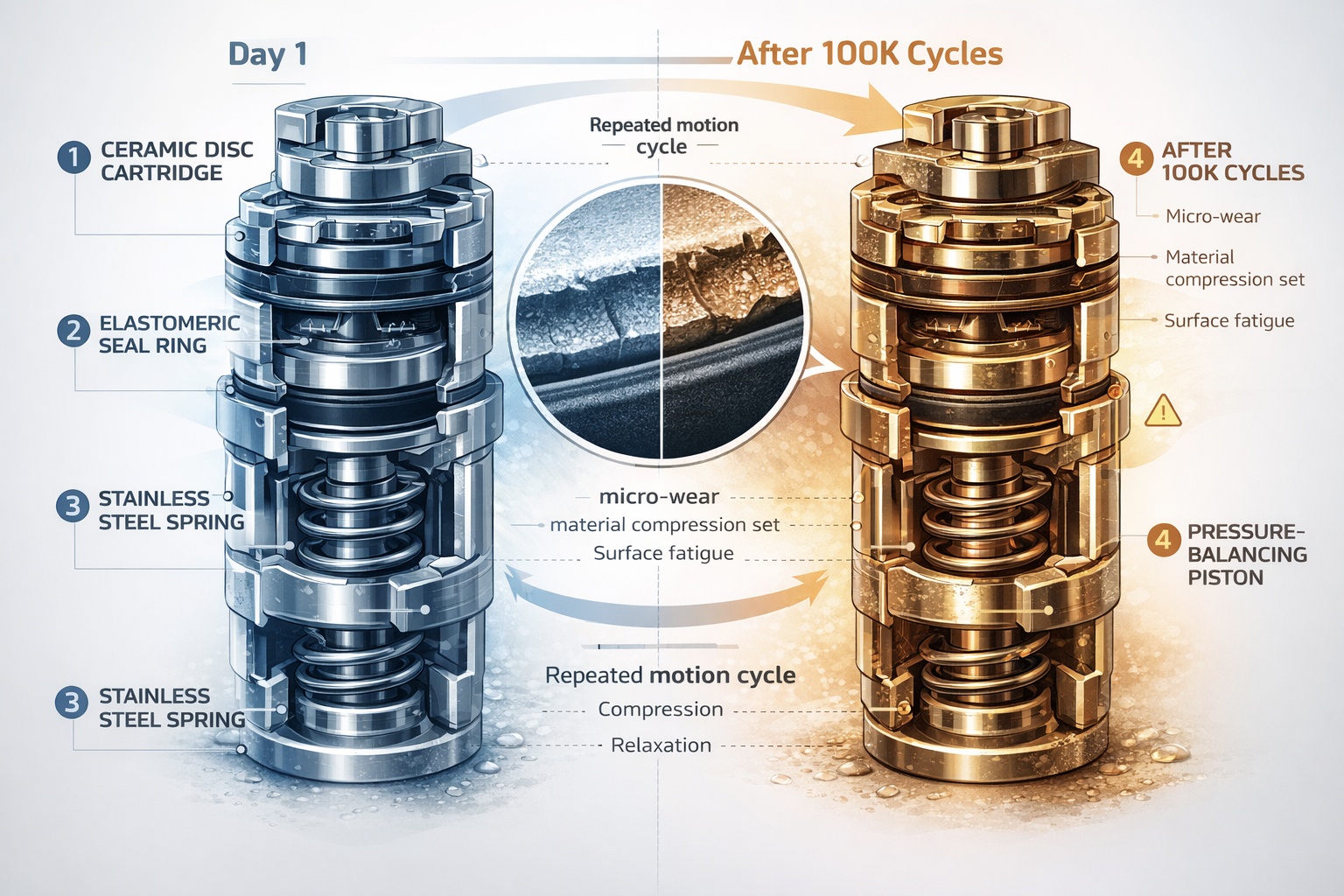
Inside every faucet or valve, a small group of components determines how the entire system behaves: cartridges, seals, springs, and pressure-balancing mechanisms.
These components are not static. They are continuously responding to pressure and movement; compressing, relaxing, sealing, and re-sealing with every use.
Over time, this repeated motion introduces subtle changes.
Not enough to stop the product from working but enough to change how it works.
A seal that once closed precisely begins to allow micro-level leakage, a cartridge starts to alter flow characteristic, a pressure-balancing mechanism still responds but no longer with the same consistency.
What changes is not function, it is precision.
Why Failures Don’t Present Clearly
Plumbing failures rarely appear as immediate breakdowns.
They tend to show up as performance drift:
- Flow that feels slightly inconsistent
- Temperature control that fluctuates
- Leakage that appears intermittently
From the outside, the product still appears functional.
Internally, it is no longer operating within the conditions it was designed for.
That gap between visible condition and internal performance — is where most reliability issues begin.
Why Initial Performance Tells You Very Little
A new fixture almost always performs well.
That only confirms that the design works under initial conditions.
What it does not account for is how internal materials and interfaces behave over time:
- How elastomeric seals respond after repeated compression
- How internal surfaces wear under friction
- How pressure cycling influences component response
- How small dimensional changes affect sealing and flow
In plumbing systems, these effects are cumulative.
They don’t appear immediately but they ultimately define long-term performance.
What Testing Is Actually Measuring
Standards such as ASME A112.18.1 / CSA B125.1 are structured around this reality.
Fixtures are subjected to repeated operational cycles often in the hundreds of thousands while maintaining pressure and operating conditions.
Performance is evaluated both before and after this endurance testing.
The objective is not simply to confirm function.
It is to determine whether the system continues to operate within defined limits as internal wear begins to take effect.
This includes:
- Leakage performance after cycling
- Changes in flow characteristics
- Consistency of operation under repeated use
These are the conditions under which real-world failures begin to emerge.
Where the Engineering Challenge Actually Lies
For manufacturers, the challenge extends beyond achieving initial performance targets.
The real difficulty lies in maintaining that performance as internal conditions evolve.
That depends on decisions that are easy to underestimate:
- How materials respond to repeated deformation
- How forces distribute across sealing surfaces
- How internal tolerances behave over time
- How components interact once wear begins
Failures rarely originate from a single component.
They emerge from how components behave together under repeated stress.
The Takeaway
Plumbing fixtures are not defined by how they perform once, but by how internal components behave as they begin to wear.
Standards such as ASME A112.18.1 / CSA B125.1 reflect this by evaluating endurance, leakage, and performance consistency after repeated operation not just initial function.
At LabTest Certification, plumbing evaluations are structured around this principle. Testing focuses on how internal components respond to repeated use, pressure conditions, and mechanical stress revealing performance changes that are not visible at installation.
Because in plumbing products, failure doesn’t begin at the surface.
It begins inside the valve long before anyone sees it.