

Bringing a product to market is a significant investment.
Months, sometimes years of engineering, design, prototyping, sourcing, and development all lead to one critical stage: independent testing.
At that point, many manufacturers begin comparing laboratories based on price, location, or the first available testing slot. While these factors certainly matter, they rarely tell the full story.
A testing laboratory doesn’t simply perform tests. It becomes part of your product’s journey to market.
The right laboratory can help keep projects moving efficiently through clear communication, technical expertise, and a well-managed testing process. The right partnership can also help reduce uncertainty, improve planning, and support long-term product development.
Before selecting a testing laboratory, here are seven questions worth asking.
1. Will This Laboratory Be a Vendor or a Long-Term Partner?
Testing is rarely a one-time activity.
Products evolve, standards are updated, new markets are explored, and future product generations often require additional evaluations. Choosing a laboratory that understands your business and products over time can make future projects more efficient while creating a stronger working relationship built on trust and familiarity.
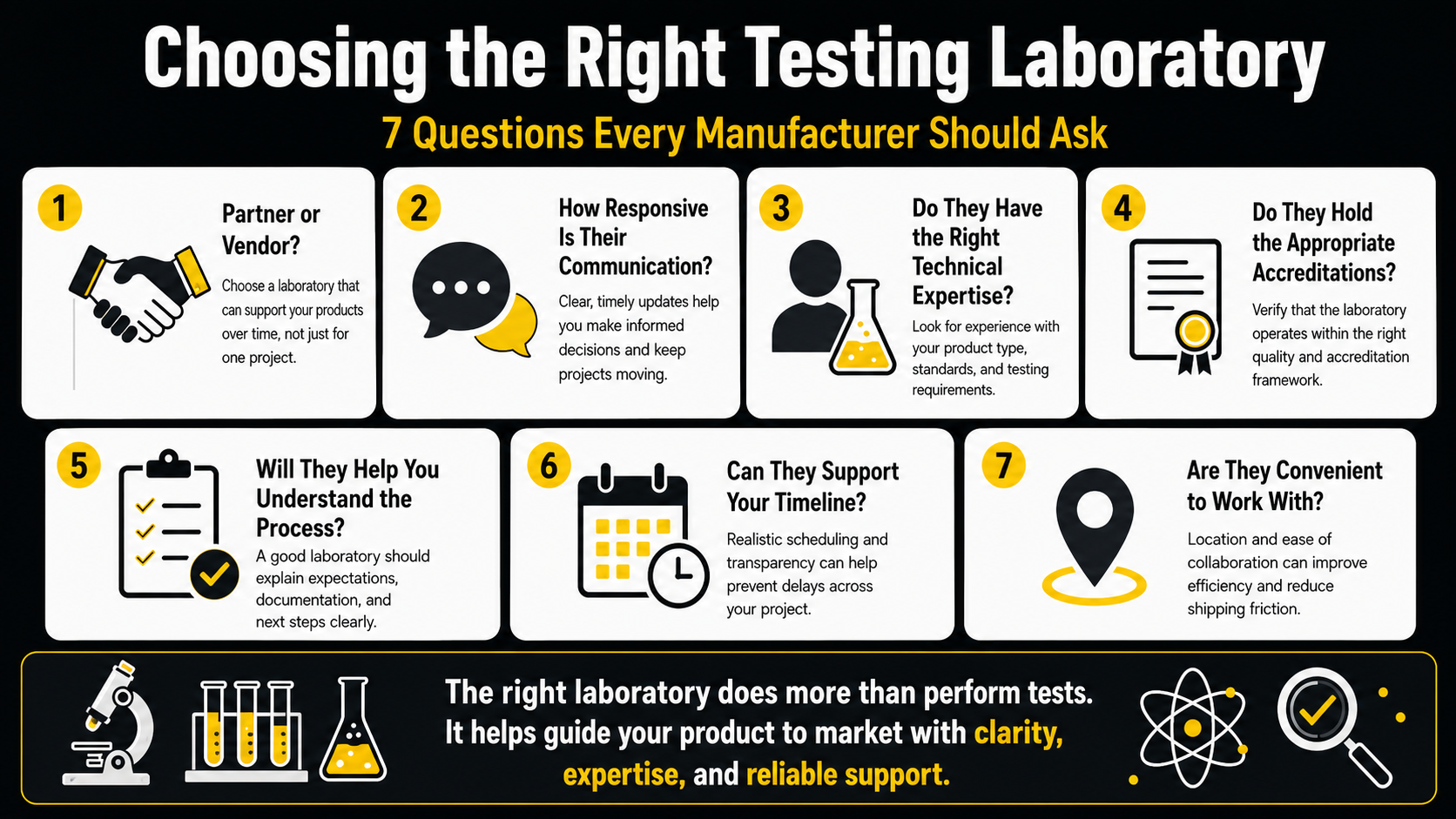
2. How Responsive Is Their Communication?
Testing projects often move alongside engineering, manufacturing, procurement, and product launch schedules.
Timely communication plays an important role throughout the process.
Whether it’s answering technical questions, providing project updates, or discussing scheduling requirements, responsive communication helps manufacturers make informed decisions and keep projects progressing with confidence.
3. Does The Laboratory Have The Technical Expertise My Product Requires?
Every product presents different challenges.
Testing industrial equipment differs significantly from evaluating batteries, building materials, lighting products, or electronic devices.
A laboratory with experienced technical staff, appropriate testing equipment, and familiarity with your product category can help ensure testing is performed in accordance with the applicable requirements while supporting a smooth project experience.
4. Does The Laboratory Hold The Appropriate Accreditations?
Accreditation provides confidence that testing is performed within an established quality framework.
Before beginning a project, manufacturers should verify that the laboratory holds the appropriate accreditations for the testing services required and that those accreditations align with the intended certification or approval pathway.
A reputable laboratory should be prepared to provide accreditation information when requested.
5. Will The Laboratory Help Me Understand The Process?
Product testing involves standards, procedures, technical documentation, and regulatory requirements that can sometimes feel overwhelming, particularly when entering a new market or developing a new product.
An experienced laboratory should be able to explain the testing process, outline project expectations, and answer technical questions clearly, helping manufacturers navigate the certification journey with greater confidence.
6. Can The Laboratory Support My Project Timeline?
Product launches are often tied to manufacturing schedules, customer commitments, and market opportunities.
Delays in testing can have a ripple effect across an entire project.
While every testing program requires appropriate time to complete, manufacturers should look for laboratories that communicate realistic timelines, provide scheduling transparency, and keep clients informed throughout the project.
7. Is The Laboratory Convenient To Work With?
Location may not always be the deciding factor, but it can influence project efficiency.
Laboratories located closer to manufacturing facilities or development teams may help simplify sample transportation, reduce shipping risks, and support faster collaboration when products require multiple rounds of testing or evaluation.
Combined with strong technical capabilities and communication, convenience can become an important part of the overall project experience.
The Right Laboratory Does More Than Perform Tests
Choosing a testing laboratory is about far more than finding a facility that can perform a test.
It’s about selecting a partner that understands your product, communicates clearly, works efficiently, and supports your compliance objectives from the initial quotation through to project completion.
At LabTest Certification, we’ve built our approach around those same principles.
With testing laboratories and offices in Delta, BC (Head Office), Richmond, BC, Oakville, ON, Las Vegas, NV, and Dallas, TX, along with a global network of partners, we support manufacturers across Canada, the United States, and international markets with accredited Testing, Inspection, and Certification (TIC) services. Our capabilities span Electrical Safety, EMC, Hazardous Locations, Marine, Building Materials, Environmental Testing, Energy Efficiency, Field Evaluations, and many other product categories.
Beyond technical expertise, we believe successful projects are built on responsive communication, practical support, transparent timelines, and long-term partnerships. Whether you’re developing your first product or expanding into new global markets, our goal is to help simplify the path to compliance while providing a professional, customer-focused experience at every stage.
Because when choosing a testing laboratory, you’re not simply selecting where your product will be tested.
You’re choosing the team that will help guide it to market.