

When LED lighting products fail electrical safety evaluations, the assumption is often the same: the fixture must be running too hot.
But the surface of the luminaire usually feels perfectly normal.
And that’s exactly the problem.
In many lighting evaluations, the temperature that determines compliance is not the one anyone can see or touch. It’s the one buried inside the system at the component level where heat behaves very differently than most design teams expect.
LED Lighting Didn’t Eliminate Heat. It Relocated It.
LED technology is often described as “cooler” than traditional lighting. Compared with incandescent sources, that’s true. LEDs convert more energy into light and less into radiant heat.
But that efficiency changes where the heat goes.
Instead of radiating outward, much of the thermal load remains concentrated inside the system, particularly around the LED junction, driver electronics, and power conversion components. If that heat is not managed effectively, internal temperatures can rise even when the outer housing remains relatively cool.
From a compliance perspective, those internal temperatures are what matter.
The Temperatures That Actually Get Evaluated
Safety standards for lighting products including UL 1598 for luminaires, UL 8750 for LED equipment, and the CSA C22.2 No. 250 series include detailed temperature testing requirements.
But the measurements involved are rarely limited to the outer surface of the fixture.
During evaluation, attention is focused on critical internal points such as:
- driver components
- wiring insulation
- LED modules and associated circuitry
- internal enclosure temperatures near sensitive materials
Thermocouples are often placed directly on components that cannot dissipate heat easily. These areas experience thermal conditions very different from what is observable externally.
A luminaire may appear comfortably cool on the outside while specific internal components are approaching their maximum rated limits.
Why Hot Spots Form in Modern LED Designs
Several design factors contribute to these internal temperature concentrations.
LED drivers are frequently enclosed in compact housings, where power conversion generates localized heat. Thermal pathways that work well for LED boards may not extend effectively to driver circuitry.
Compact form factors can also trap heat inside the luminaire enclosure. What appears to be a small design decision; driver placement, enclosure geometry, or airflow restriction can significantly influence internal temperature behavior.
Another factor is the increasing integration of components. As luminaires become slimmer and more architecturally integrated, internal clearances shrink, reducing the ability for heat to dissipate naturally.
The result is a common compliance surprise: a product that appears thermally stable externally can still exceed limits internally.
Why This Matters for Manufacturers
Temperature limits in safety standards are not arbitrary. They are tied directly to material ratings, insulation systems, wiring temperatures, and component reliability thresholds.
If internal components exceed those limits during testing, the issue is not simply about momentary performance. It can signal long-term reliability concerns or insulation degradation over time.
For manufacturers, this means that thermal design must consider more than the visible heat profile of the fixture.
Internal heat distribution, component placement, and driver architecture can all influence whether a product remains within acceptable temperature limits during evaluation.
The Design Insight Many Teams Miss
One of the most overlooked aspects of LED luminaire design is that thermal behavior is rarely uniform.
Heat does not distribute evenly through a lighting system. It concentrates at specific electrical and mechanical interfaces; junctions, conversion components, enclosed electronics, and areas with limited airflow.
Understanding where those concentrations occur often determines whether a luminaire passes temperature testing or requires redesign.
In other words, the most important temperature in the system may be the one no one initially planned to measure.
Takeaway
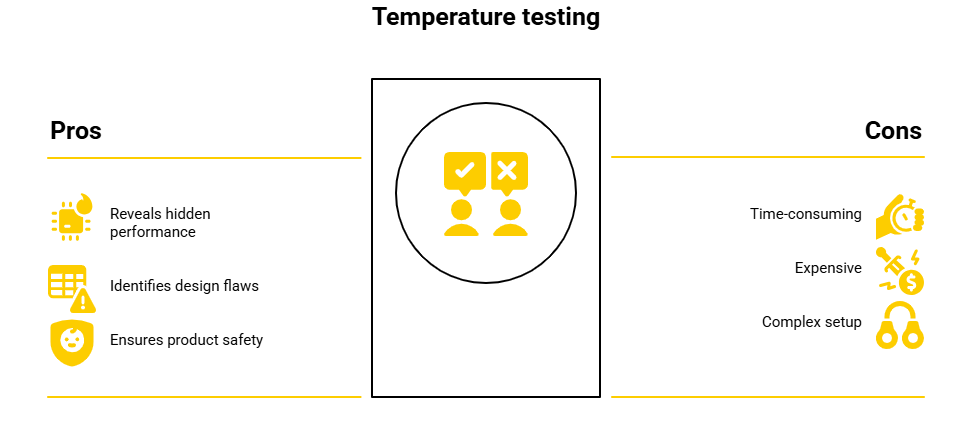
In lighting product evaluations, temperature testing often reveals performance details that are not visible during normal operation.
At LabTest Certification, these internal measurements frequently highlight thermal behavior that differs from initial design expectations particularly in compact LED systems where driver placement and enclosure design strongly influence heat distribution.
As LED luminaires continue evolving toward smaller, more integrated designs, understanding these hidden thermal dynamics is becoming increasingly important for manufacturers preparing products for safety evaluation.