

Most electronics are designed with a familiar environment in mind: a building, a vehicle cabin, or a controlled industrial setting.
Marine equipment lives somewhere else entirely.
Out at sea, electronics face a combination of forces that rarely appear together in land environments: salt-laden air, continuous vibration, humidity that never truly disappears, and temperature swings that cycle day after day.
Individually, each of these conditions is manageable.
Together, they quietly change how electronics age and perform.
Salt Doesn’t Just Corrode, It Conducts
Saltwater corrosion is the risk most people immediately recognize. Metal housings, connectors, and exposed conductors can degrade quickly when exposed to saline environments.
But corrosion is only part of the story.
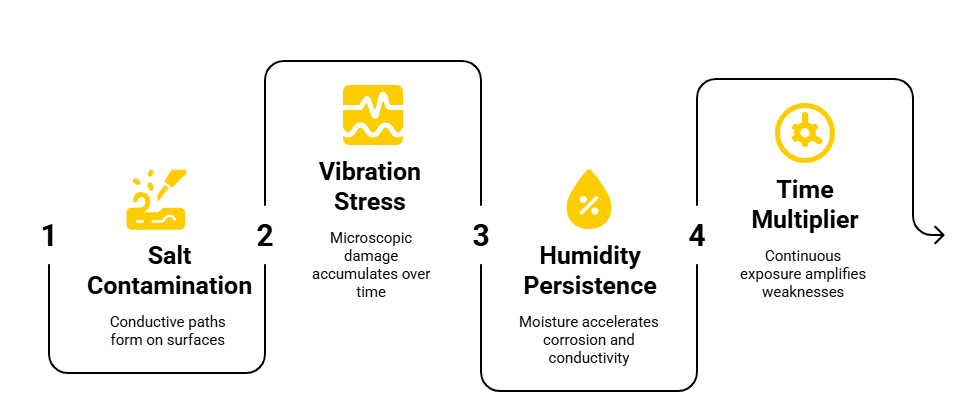
Salt residues left behind after evaporation form microscopic conductive paths across surfaces. On circuit boards and connector interfaces, those deposits can create unintended electrical paths. Under the right humidity conditions, the salt effectively becomes a thin electrolyte layer.
This means electrical isolation distances that appear sufficient in a clean environment can behave very differently once salt contamination enters the system.
In extreme cases, equipment doesn’t just fail dramatically. Instead, it begins behaving unpredictably; intermittent faults, sensor drift, or communication errors that appear and disappear depending on moisture levels.
Vibration Turns Small Weaknesses Into Failures
Marine vessels rarely sit still.
Engines generate constant vibration. Hull motion introduces cyclic stresses. Even moderate sea conditions subject onboard equipment to continuous mechanical movement.
Electronics that appear structurally sound in static conditions may experience slow degradation when exposed to vibration over time.
Connectors loosen microscopically. Solder joints fatigue. Cable routing points experience repeated stress. Components mounted on circuit boards endure thousands of micro-flex cycles.
None of these events cause immediate failure. But over months or years, they accumulate.
This is why marine testing often incorporates vibration and mechanical endurance testing to simulate the stresses electronics will face in real operation.
Humidity Is the Constant Companion
Unlike many terrestrial environments where humidity fluctuates, marine air rarely dries out completely.
Moisture persists inside enclosures, inside connectors, even within protective coatings if those coatings are imperfect.
High humidity accelerates corrosion reactions and increases the conductivity of surface contaminants. It also affects insulation materials and can influence how electrical clearances behave over time.
What might appear to be a sealed enclosure on day one may slowly accumulate moisture through microscopic gaps, pressure cycling, or temperature-driven condensation.
Over time, the internal environment changes.
Time Is the Multiplier
None of these environmental factors are especially destructive in a single exposure.
The real challenge is duration.
Marine electronics are expected to operate reliably for years while exposed to these conditions continuously. Salt deposition repeats. Vibration cycles accumulate. Moisture levels remain elevated.
A small design weakness that would never appear in short-term testing can gradually evolve into a reliability issue when subjected to these stresses day after day.
That is why marine compliance often include corrosion testing, humidity exposure, temperature cycling, and vibration testing sometimes in combination to simulate the aging process that occurs offshore.
Designing for the Environment You Can’t See
For engineers developing equipment destined for marine environments, the biggest challenge is that the most damaging conditions are not always visible.
Salt residue may appear as a faint film. Vibration damage begins at microscopic scales. Humidity infiltration happens slowly and quietly.
Yet those invisible factors are often what determine long-term reliability.
Testing for these conditions does not simply verify whether a product works today.
It reveals how the product will behave after years of exposure to the unique stresses of life at sea.
The Takeaway
Marine electronics are rarely evaluated in isolation. Approval often requires demonstrating compliance with standards such as IEC 60945 for maritime navigation and radio communication equipment, along with environmental and electrical safety requirements recognized in Canada and the United States such as ABYC S-31 Environmental Considerations For Electronic Systems and Components Installed on Boats.
At LabTest Certification, these evaluations often reveal that the real challenge is not a single environmental condition, but how design decisions hold up when salt exposure, vibration, humidity, and electrical stresses interact within the same system.
In marine environments, reliability is not just engineered, it is proven under the conditions where the equipment will actually operate.