

Bringing a new product to market is exciting. But between brainstorming, prototypes, and production runs, there’s one stage that often throws manufacturers off balance: certification testing.
This is where a product meets the ultimate reality check. Will it actually hold up under stress? Is it as safe as you think? Or will a hidden design flaw send it straight to the “try again” pile, or worse, into the recall headlines?
At our testing labs, we’ve seen it all: products that nearly pass with flying colors, others that fail in spectacular (and sometimes smoky) fashion, and a few that leave us scratching our heads wondering, “How did this even make it off the drawing board?”
To save you from the same fate, let’s walk through some of the usual suspects, the problems we see most often, and a few real-life stories of what happens when they slip through the cracks.
The Repeat Offenders
Some issues just keep showing up, no matter the product type or the brand. Here are the most common culprits: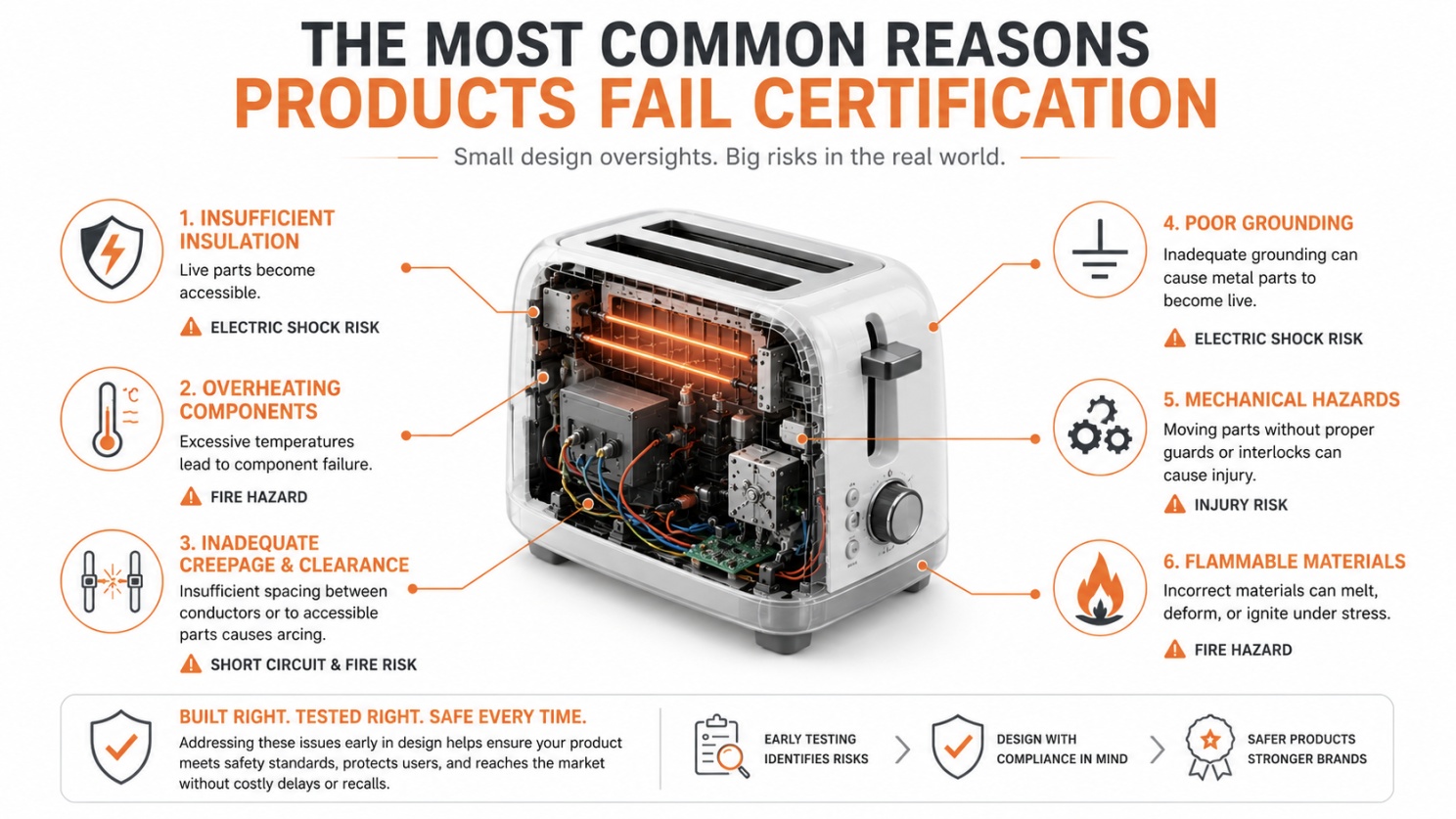
- Insufficient insulation Think of insulation as the invisible barrier keeping electricity where it belongs. Without enough of it, live parts can become accessible, and suddenly your “safe” appliance is an electric shock waiting to happen.
- Overheating components A little warmth is fine. A toaster catching fire in your kitchen? Not so much. When parts run too hot, they don’t just fail; they can ignite.
- Inadequate creepage and clearance distances Fancy terms, simple idea: wires and conductors need space apart, or they’ll arc across each other like tiny lightning bolts. At best: a short circuit. At worst: fire.
- Poor grounding Without proper grounding, metal housings can turn into electrified traps. Imagine touching your shiny new blender only to get zapped; definitely not the “spark” you had in mind.
- Mechanical hazards Moving parts need guards and interlocks. A blender blade spinning freely without safety measures? That’s less “smoothie” and more “ER visit.”
- Flammable materials Using the wrong plastic or subpar materials can mean casings that melt, deform, or catch fire under stress. The savings on cheaper material isn’t worth the recall (or the lawsuits).
Real-Life Examples That Made Headlines
Testing labs and regulators aren’t just making up these requirements for fun. They come from very real product failures. Here are a few that stand out:
🔥 Portable Electric Heaters
- Issue: Internal wiring placed too close to heating elements.
- Outcome: Insulation broke down, causing fire risks. Several recalls across North America followed. Third-party testing flagged overheating and inadequate thermal cutoffs.
👕 Clothes Dryers
- Issue: Lint accumulation near heating elements.
- Outcome: Fires were reported, leading to major recalls. Today, certification testing includes stricter checks for airflow and lint traps, because nobody wants “wash day” turning into “fire drill.”
📱 Counterfeit Phone Chargers
- Issue: Microscopic spacing between high-voltage and low-voltage parts, sometimes as little as 0.1 mm (the thickness of a human hair).
- Outcome: Failed dielectric strength and leakage current tests. Seizures by regulators, shocking (literally) electrocution risks, and more than a few house fires. A painful reminder that knockoffs are cheap for a reason.
🍞 Toasters (UK Recall)
- Issue: Poor internal wiring design. Live parts accessible when removing stuck bread.
- Outcome: Failed IEC 60335-1 electric shock protection tests, pulled off shelves. Because no one expects breakfast to bite back.
☕ Kettles (EU Market)
- Issue: Handles made of bargain-bin plastic softened under heat, causing boiling water spills.
- Outcome: Failed thermal endurance and mechanical strength tests. Burns, recalls, and a big lesson: if your handle can’t handle boiling water, maybe it shouldn’t be a kettle.
🌀 Vacuum Cleaners
- Issue: Power cords with undersized conductors overheated after extended use.
- Outcome: Recall after certification labs measured temperatures well above safe limits. Turns out “hot mess” isn’t the cleaning result customers are looking for.
Why These Problems Keep Happening
Here’s the kicker: most of these issues aren’t the result of cutting-edge, complicated failures. They’re basic design oversights that repeat across industries.
Why? A few reasons:
- Pressure to reduce costs and time to market leads to cheaper materials.
- Design teams may assume “it worked in the prototype” means it’ll work in mass production.
- Safety testing isn’t considered early enough in the process.
The Takeaway for Manufacturers
Here’s the good news: most of these failures are preventable!
By thinking about safety and compliance from day one, and not as a final checkbox, you’ll save money, time, and avoid the nightmare of a product recall (not to mention brand damage).
In other words: don’t wait for a certification body to be the one to point out that your kettle handle melts, or that your toaster is playing with live wires. Build compliance into your design, and your path to market will be a whole lot smoother.
💡 Final Thought: Products don’t fail certification to make your life harder. They fail because testing reveals how they’ll behave in the real world, where customers expect them to work safely, every time. Treat certification as your rehearsal before the big performance, not the obstacle in your way.