

In recent years, wildfires across Canada and parts of the United States have brought renewed attention to how buildings respond under fire exposure.
When structures are affected, the focus is often on outcomes like what failed, what remained, and what could have performed differently.
But long before that, a more fundamental question is defined during testing.
What aspects of fire behavior are actually being measured?
Fire Performance Is About Behavior, Not Just Resistance
Fire is often thought of in binary terms.
A material either resists it, or it doesn’t.
In reality, materials don’t simply “withstand” fire.
They react to it.
That reaction can include:
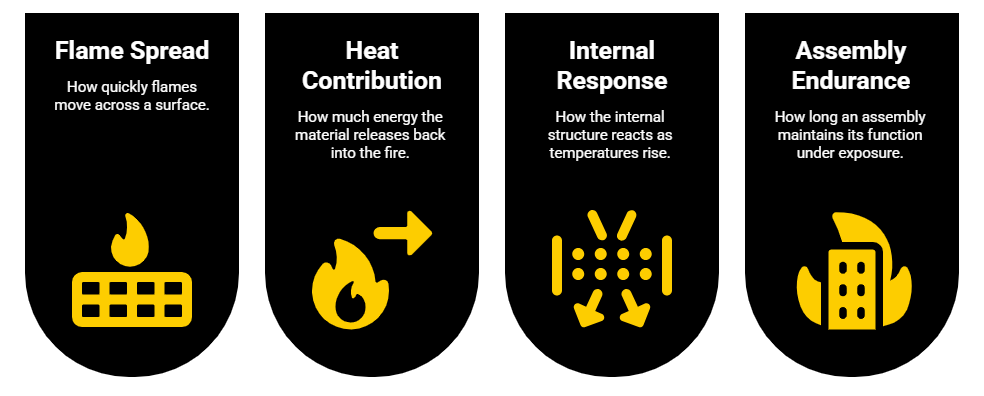
- how quickly flames move across a surface
- how much energy the material contributes back into the fire
- how internal structure responds as temperatures rise
- how long an assembly can maintain its function under exposure
Each of these behaviors influences how a fire develops not just how a material survives it.
Different Tests Answer Different Questions
Fire testing is not designed to produce a single measure of performance.
It separates fire into measurable components.
For example:
- ASTM E84 evaluates how flame spreads and how much smoke is generated along a material’s surface
- CAN/ULC S101 assesses how long an assembly can maintain structural integrity and limit heat transfer
These tests are fundamentally different.
One looks at how a fire travels. The other looks at how long a system holds.
Neither replaces the other.
Where Complexity Actually Shows Up
The challenge isn’t that systems can’t handle power flowing both ways.
It’s that they now have to handle:
- switching between load and source
- dynamic interaction with the grid
- coordination between multiple energy systems (vehicle, home, storage)
- conditions that weren’t part of traditional one-way design logic
What used to be a simple relationship becomes an interactive system.
The Role of Time: The Factor Most People Miss
One of the most critical elements in fire performance is time.
Not just whether a material reacts to fire but how quickly that reaction progresses.
Two materials may both be classified within acceptable limits. But:
- one may contribute heat rapidly in early stages
- another may maintain stability longer under sustained exposure
That difference changes how a fire evolves within a space.
And it’s something only specific test methods are designed to capture.
Why Assemblies Matter More Than Materials
Fire does not interact with materials in isolation.
It interacts with systems.
A wall, floor, or ceiling assembly is made up of layers:
- structural components
- insulation
- finishes
- air gaps
Each layer influences how heat moves, how flames spread, and how long the system remains intact.
A material’s individual performance is only one part of that behavior.
The assembly determines the outcome.
What Testing Is Actually Designed to do
Fire testing does not attempt to replicate every possible fire scenario.
Instead, it creates controlled conditions that isolate specific behaviors:
- surface flame spread
- heat release contribution
- structural endurance
This allows those behaviors to be measured consistently and compared across materials and systems.
The goal is not to predict a single outcome.
It is to understand how different aspects of fire response behave under defined conditions.
Where we come in
At LabTest Certification, fire testing of building materials and assemblies is conducted in accordance with established standards that evaluate distinct aspects of fire behavior.
This includes understanding how materials contribute to flame spread, how assemblies respond over time, and how heat transfer is controlled under exposure.
The value of these evaluations lies not in a single result but in how each measured behavior contributes to a broader understanding of fire performance.
LabTest Certification will also be able to conduct propagation fire tests on energy storage systems as per UL 9540A. Coming soon, open for inquiries.
Takeaway
Fire performance is not defined by a single property.
It is a combination of behaviors: how materials react, how assemblies respond, and how those responses change over time.
Testing breaks these behaviors into measurable components.
And understanding those components is what allows fire performance to be interpreted meaningfully.
Because in fire scenarios, it’s not just what a material is.
It’s how it behaves and how long that behavior holds.