

When e-scooter safety is discussed, the focus is almost always on design.
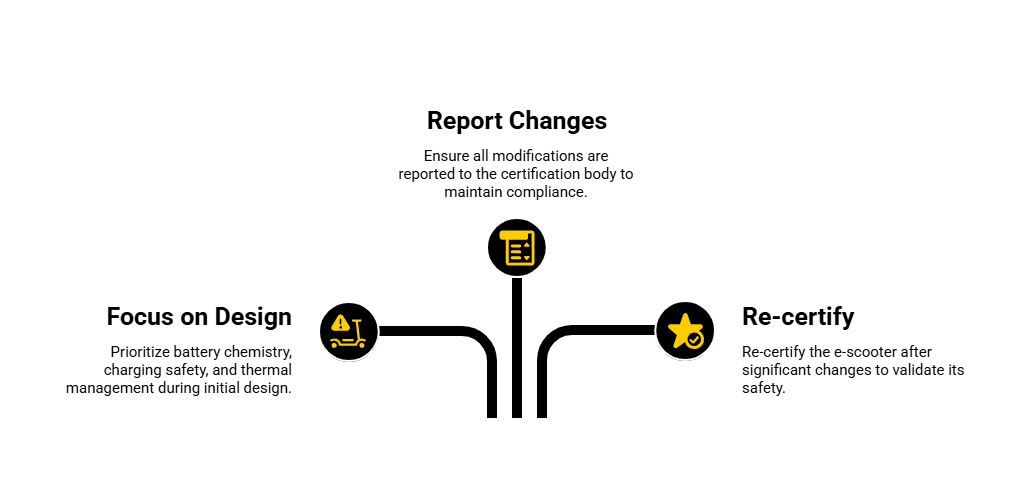
Battery chemistry. Charging safety. Thermal management.
But for manufacturers and fleet operators, the more significant compliance risk often appears later, long after the original design has been evaluated.
It appears when the product in circulation is no longer identical to the product that was certified.
Certification Applies to a Specific Build, Not a Product Line
When a scooter is evaluated under standards such as UL 2272, the assessment applies to a specific, defined configuration. A particular battery pack, controller architecture, wiring layout, protection strategy, and charging interface are examined together as an integrated system. Battery assemblies assessed under UL 2271 or UL 62133 are not interchangeable in practice simply because ratings look comparable.
Testing verifies how that exact system behaves under normal and abnormal conditions including single fault scenarios, overcurrent events, and thermal stress.
Certification, therefore, is not an endorsement of a product category.
It is validation of a specific architecture at a specific moment in time.
Where Risk Actually Emerges
Micromobility devices rarely remain static.
Firmware is updated to optimize range or torque response. Fleet operators replace internal modules to extend service life. Controllers are substituted during maintenance. Alternative chargers enter the ecosystem.
None of these actions are unusual. Many are commercially necessary.
The risk arises when these changes are not reported to the third-party who evaluated and certified the product. That is because unless the compliance report matches the products, the certification is not valid
Because once the evaluated architecture shifts even subtly, the original test assumptions may no longer fully apply.
That does not automatically make the product unsafe.
But it does mean the certification no longer perfectly reflects the device in operation.
Firmware Is Not Just Software, It Is a Protection Parameter
One of the least appreciated aspects of micromobility compliance is that firmware often defines safety boundaries.
Current limits. Cutoff thresholds. Regenerative braking response. Fault detection logic.
If those parameters were part of the evaluated protection strategy, altering them changes the conditions under which protection circuits were assessed.
In many electrical standards, protective behavior under fault is central to compliance.
Change the behavior, and you may change the compliance basis.
The Configuration Management Gap
Traditional consumer electronics are sealed. Their configuration rarely changes in the field.
E-scooters are different. They are serviced. Repaired. Updated. Maintained at scale. Yet many manufacturers do not formally treat post-market component substitution and firmware revision as compliance-impacting events. They treat them as operational updates.
That gap between engineering change and regulatory awareness is where exposure develops.
Not because of reckless design. But because compliance is assumed to be permanent.
What This Means for Manufacturers and Fleet Operators
The question is not whether modification should be allowed. The question is whether configuration control is formalized.
- Are replacement components validated against the evaluated architecture?
- Are firmware revisions assessed for impact on protection behavior?
- Is documentation updated when internal system behavior changes?
- Is there a defined boundary around what constitutes an approved configuration?
In micromobility, certification should not be treated as a one-time event. It should be treated as a controlled baseline.
When that baseline shifts, it must be acknowledged, not assumed to hold.
Perspective
At LabTest Certification, we increasingly see compliance questions emerge not from initial design flaws, but from unmanaged lifecycle changes.
As personal mobility devices become more sophisticated and service-driven, configuration governance is becoming just as important as initial testing.
Because in integrated electrical systems, compliance is not only about how the product was built. It is about whether the product in circulation still reflects what was evaluated.