

Ingress Protection ratings are often reduced to a simple idea.
A number.
A label.
An assumption that a product is “waterproof” or “dustproof.”
But that rating is not a claim.
It is the result of a very specific sequence of tests, each designed to answer a different question.
Test Configuration Defines the Results
IP testing doesn’t begin with spraying or submerging a product.
It starts with defining the exact configuration being tested:
- cable entries
- seals and gaskets
- mounting orientation
- intended use
Because small differences here change how a product behaves under exposure.
The test is not just about the product.
It’s about the product as it will actually be used.
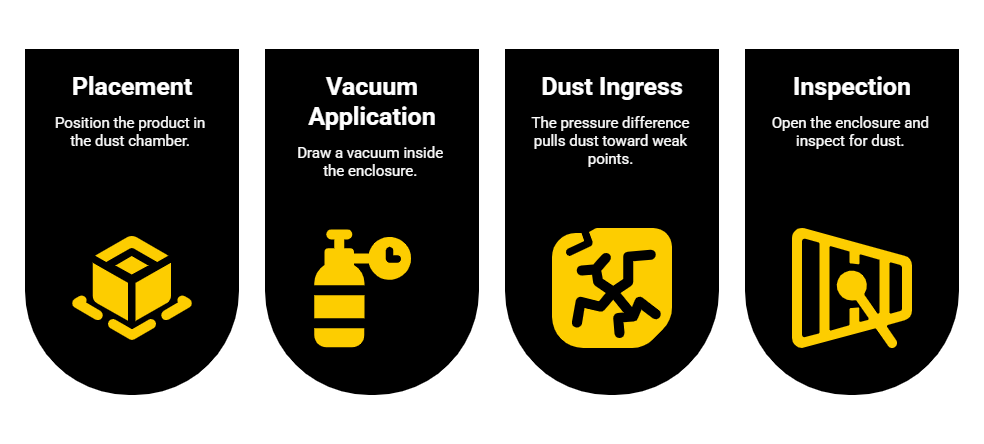
The Dust Test: Negative Pressure, Not Just Exposure
For dust protection (IP5X / IP6X), the product is placed inside a dust chamber.
But it’s not just sitting in dust.
A vacuum is often applied.
This creates a pressure difference that actively draws dust toward potential entry points.
- seals
- joints
- cable interfaces
This is not passive exposure.
It’s a forced condition designed to find weaknesses.
Water Exposure Is Directional and Quantified
Water tests vary depending on the rating:
- IPX4 → splashing
- IPX5/IPX6 → high-pressure jets
- IPX7 → temporary immersion
- IPX8 → continuous immersion
But the key detail most people miss is this:
👉 The direction, pressure, duration, and distance are controlled.
Water is applied from specific angles, at defined flow rates, for a set period of time.
Because the goal is not to see if water touches the product.
It’s to see whether it enters.
The Pass/Fail Isn’t Always Obvious
After exposure, the product is not judged by appearance alone.
Evaluation depends on:
- internal inspection
- functional checks
- presence of dust or water in critical areas
A product may look completely dry externally.
But still fail due to ingress into sensitive components.
The Pass/Fail Isn’t Always Obvious
After exposure, the product is not judged by appearance alone.
Evaluation depends on:
- internal inspection
- functional checks
- presence of dust or water in critical areas
A product may look completely dry externally.
But still fail due to ingress into sensitive components.
Why Small Details Matter More Than Expected
IP testing often comes down to very small things:
- compression of a gasket
- torque applied to a fastener
- alignment of a sealing surface
These are not major design features.
But they determine whether the enclosure holds under stress.
Which means performance is not just about design, it depends on how consistently that design is executed.
What This Means for Manufacturers
IP ratings are not broad claims.
They are tied to a specific tested configuration.
If something changes:
- enclosure design
- material
- cable entry
- sealing method
The performance can change with it.
Because the rating reflects how that exact version behaved under test conditions.
Where LabTest Comes In
At LabTest Certification, IP testing is conducted under controlled conditions that replicate defined exposure scenarios for dust and water ingress.
This includes evaluating products under pressure differentials, directional water application, and immersion conditions aligned with applicable IP ratings.
The focus is not just on exposure.
It is on how the enclosure performs when subjected to conditions designed to challenge its weakest points.
In addition to IP testing, LabTest Certification also conducts NEMA Type testing — evaluating enclosure performance against environmental conditions such as corrosion, ice formation, and oil exposure. This extends ingress protection beyond dust and water alone, and will be explored further in the next article.
Takeaway
An IP rating is not a general measure of durability.
It is the result of a controlled set of conditions applied to a defined product configuration.
And in practice, whether a product meets that rating depends less on exposure and more on how precisely the enclosure is built to resist it.