

When a window or door is installed, it may appear completely finished.
The frame is sealed. The glass is in place. The exterior looks complete.
But performance problems are often invisible at that stage.
Because the most critical failures are not usually aesthetic.
They happen within the building envelope itself:
- uncontrolled air leakage
- water penetration under pressure
- gradual moisture intrusion
- long-term performance loss
And in many cases, these issues are only discovered months or years later after surrounding materials have already been affected.
That is why on-site accredited fenestration testing matters.
Not simply to verify compliance. But to evaluate how installed products actually perform under real-world conditions.
Laboratory Performance vs Installed Performance
A product may perform well during laboratory evaluation.
But once installed, performance is influenced by much more than the product alone.
Factors such as:
- installation quality
- interface sealing
- surrounding construction
- anchoring and alignment
- site conditions
can all influence how the assembly behaves in service.
This is why on-site testing plays a different role from laboratory testing.
It evaluates the installed system in its actual construction environment.
Because a high-performance product can still experience issues if the installation conditions compromise the assembly.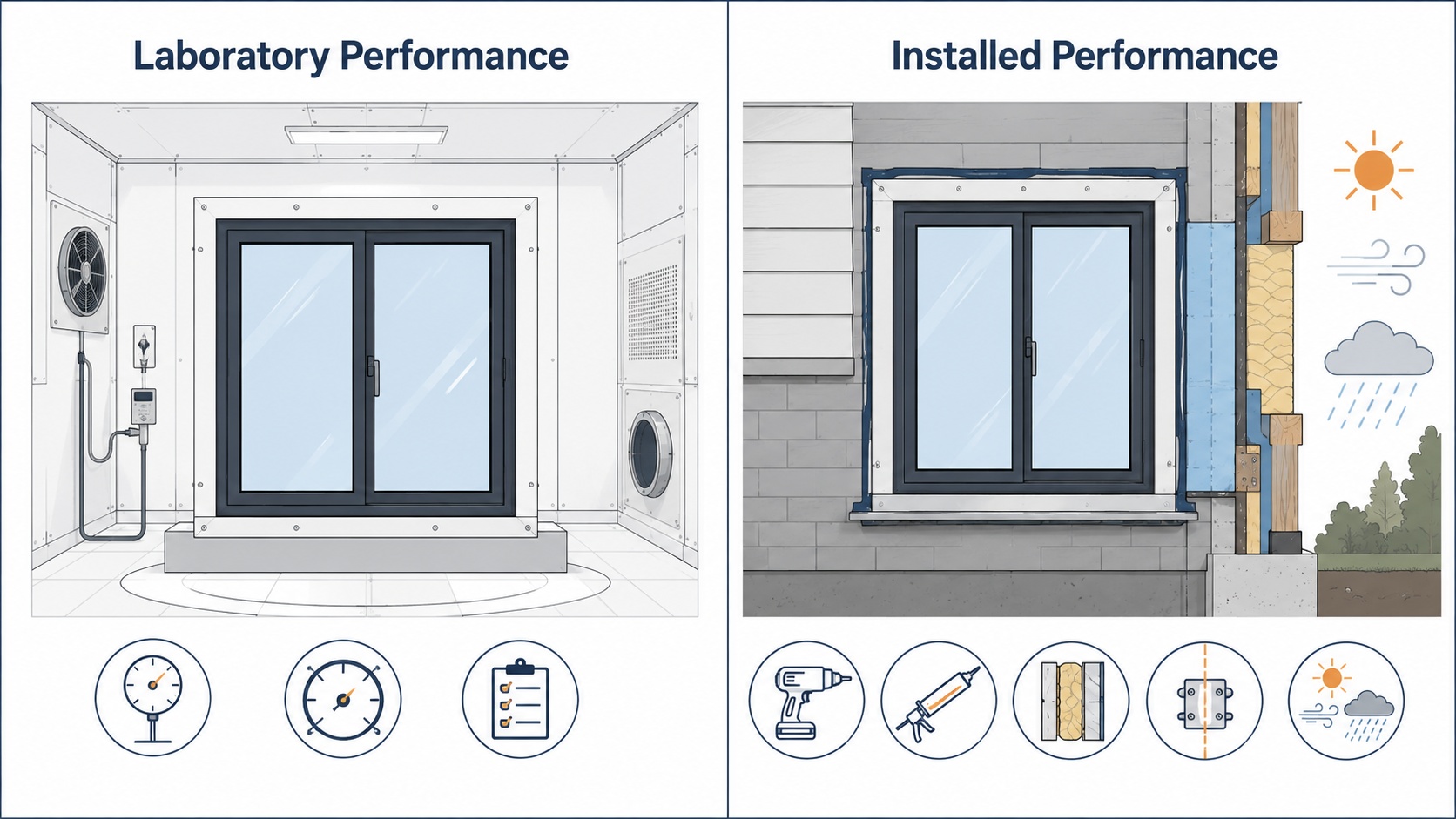
The Two Main On-Site Evaluations
On-site NAFS-related evaluations typically involve two primary tests:
- air leakage testing
- water penetration testing
Together, these evaluations help assess how effectively installed windows and doors resist uncontrolled air and water movement under pressure conditions.
Air Leakage Testing: Measuring What Cannot Be Seen
Air leakage is often underestimated because it is rarely visible.
But uncontrolled air movement can significantly affect:
- energy performance
- thermal efficiency
- occupant comfort
- long-term building
- envelope performance
During testing, one face of the installed window or door is sealed and a controlled differential pressure (typically 75 Pa) is applied across the assembly by supplying air to or removing air from the sealed chamber.
The airflow required to maintain the target pressure is then measured.
The air leakage rating is calculated based on:
- the flow rate required to achieve the target pressure
- the size of the window or door
- surrounding environmental conditions
Testing is performed in accordance with ASTM E783.
The purpose of the evaluation is to quantify how much uncontrolled air leakage occurs through the installed assembly.
Certain air leakage limits are commonly established by national and provincial building codes, while stricter project-specific requirements may also be specified by building envelope consultants, architects, or engineers.
Because even relatively small leakage paths can negatively impact overall energy performance.
All instrumentation used during testing is ISO 17025 calibrated, including:
- laminar flow elements
- pressure sensors
- environmental data loggers
- dimensional measurement tools
Water Penetration Testing: Evaluating the Assembly Under Pressure
Water penetration testing evaluates how installed products respond when exposed to both water spray and pressure differential conditions.
During testing:
- the interior side of the assembly is sealed
- a pressure differential is applied by removing air from the sealed chamber
- water is uniformly sprayed onto the exterior surface using a calibrated spray rack
The evaluation is conducted in repeating six-minute cycles.
Pressure is applied for five minutes and removed for one minute while water spray continues throughout the procedure.
To meet the test requirements, the assembly must withstand four complete cycles, a total test duration of 24 minutes without water penetration.
Products are evaluated based on the pressure differential they can withstand while maintaining resistance to water intrusion.
Testing is performed in accordance with ASTM E1105.
The objective is to evaluate the water tightness of installed products under controlled field conditions.
Because leaks are often connected to interfaces, transitions, or installation-related conditions that may not become obvious immediately after construction.
All instrumentation used during testing is ISO 17025 calibrated to support repeatability and measurement accuracy.
Why On-Site Testing Matters So Early
One of the most important advantages of on-site testing is timing.
Problems often remain hidden for months or years after installation, when they become significantly harder and more costly to identify and repair.
By performing testing shortly after installation, potential issues may be identified before surrounding materials experience long-term moisture-related damage.
This allows corrective actions to be addressed earlier in the construction process.
And in building envelope performance, early identification matters.
Because moisture intrusion rarely remains isolated to one location.
Why Accuracy and Repeatability Matter
On-site testing is only valuable when the measurements themselves are reliable.
At LabTest Certification, all instrumentation used during testing is ISO 17025 calibrated.
This includes equipment such as:
- laminar flow elements
- pressure sensors
- environmental data loggers
- dimensional measurement tools
Testing is conducted under ISO 17025 accreditation to support repeatability, accuracy, and consistency of measurement.
Because building envelope decisions are often based directly on the data produced during these evaluations.
The Difference Between Controlled Testing and Improvised Evaluations
Not all field evaluations are performed under controlled testing methodologies.
Improvised approaches using uncontrolled spray methods or non-calibrated equipment may not produce repeatable or technically meaningful results.
Controlled on-site testing is designed around:
- calibrated instrumentation
- standardized procedures
- measurable pressure conditions
- repeatable evaluation methods
The goal is not simply to “spray water at a window.”
It is to evaluate installed performance under defined test conditions that can be consistently measured and documented.
Where LabTest Comes In
LabTest Certification provides on-site testing for windows and doors under ISO 17025 accreditation.
Evaluations include:
- air leakage testing in accordance with ASTM E783
- water penetration testing in accordance with ASTM E1105
Testing is conducted using calibrated instrumentation designed to support accurate and repeatable measurements under controlled field conditions.
The objective is to evaluate installed performance early enough to identify potential issues before long-term building envelope impacts develop.
Takeaway
A window or door may appear fully installed while critical performance issues remain completely hidden.
Air leakage and water penetration are often not visible immediately.
But over time, uncontrolled movement of air and moisture can affect energy performance, surrounding materials, and long-term building envelope durability.
On-site testing evaluates how installed assemblies actually perform under controlled conditions.
Because in building envelope performance, the most expensive problems are often the ones that are discovered too late.