

Corrosion is rarely immediate.
Most failures begin long before visible damage appears:
at a coating edge,
around a fastener,
at a spot welding,
inside a seam,
or beneath a surface imperfection that initially seems insignificant.
And once corrosion begins, the visible damage is often only the final stage of a much larger degradation process.
That is what salt spray testing is designed to accelerate and reveal.
The Test Is About Surface Protection Systems
One of the biggest misconceptions about salt spray testing is that it evaluates the metal itself.
In many cases, it is actually evaluating the protective system surrounding that metal:
- coatings
- plating
- paint finishes
- conversion layers
- surface preparation quality
Because corrosion resistance is often determined less by the substrate alone and more by how effectively the surface remains protected under exposure.
Two products may use the same base material.
But differences in:
- coating thickness
- adhesion quality
- finishing consistency
- edge coverage
can produce completely different corrosion behavior during testing.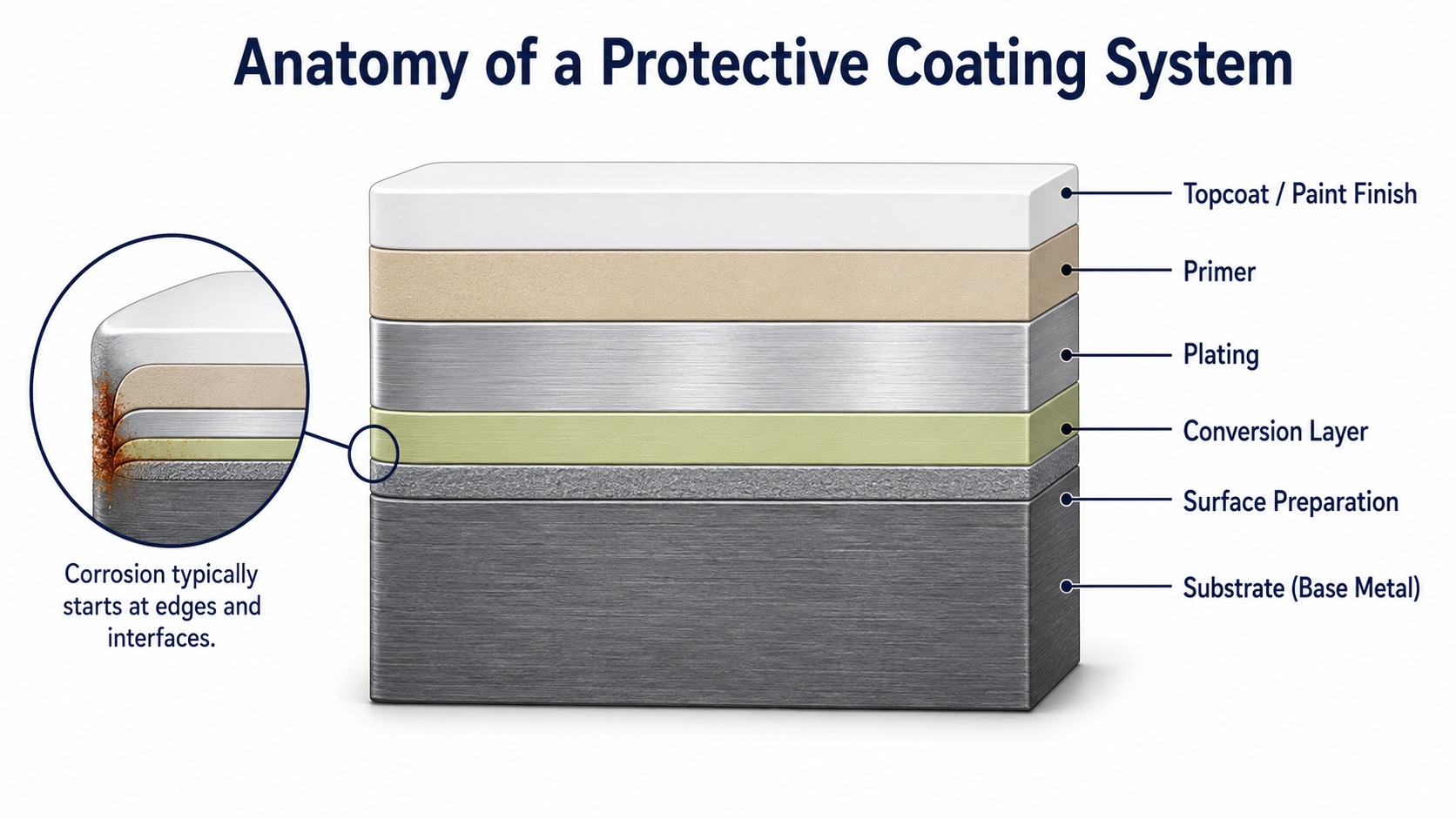
Salt Spray Testing Is Built Around Controlled Exposure
Salt spray testing also referred to as salt fog or salt mist testing exposes specimens to a continuous corrosive environment inside a controlled chamber.
But the important part is not simply the presence of salt.
It is the repeatability of the conditions.
Variables such as:
- salt concentration
- chamber temperature
- pH
- spray collection rate
- fog distribution
are controlled throughout the test because corrosion behavior changes significantly when those parameters shift.
The objective is not to recreate a random harsh environment.
It is to create a stable corrosive condition where material and coating performance can be consistently evaluated.
Why Corrosion Often Starts at the Smallest Defects
Corrosion rarely develops uniformly across a product surface.
It typically initiates at interruption points:
- cut edges
- scratches
- welds
- corners
- joints
- fastener interfaces
- transitions between
- dissimilar materials
These areas experience stress differently from flat protected surfaces.
And once the protective layer is compromised, degradation can begin underneath the surrounding finish long before widespread corrosion becomes visible.
This is why salt spray testing is often valuable for identifying weaknesses in the protection system itself not just visible surface failure.
The Results Are About Behavior, Not Just Hours
A common mistake is reducing salt spray performance to a single number:
“500 hours.”
“1000 hours.”
But exposure duration alone does not explain:
- where corrosion initiated
- how coatings deteriorated
- whether blistering or
- delamination occurred
- how corrosion propagated beneath the surface
The evaluation is not only about how long a specimen resists exposure.
It is about understanding how the protective system behaves throughout the progression of corrosion.
Why This Matters More Over Time
Type Ratings are not just about how an enclosure performs during testing.
They reflect how it is expected to hold up through actual use.
Performance differences don’t usually appear immediately.
They emerge as the enclosure is:
- repeatedly exposed to its operating environment
- subjected to mechanical and installation-related stresses
- relied upon to maintain its construction and sealing over time
This is where construction, material selection, and assembly quality begin to matter more than initial performance.
Because long-term reliability is not defined at installation.
It is defined by how consistently the enclosure maintains its integrity in service.
Different Standards Simulate Different Exposure Conditions
Salt spray testing is performed under different standards depending on the product, industry, and intended operating environment.
At LabTest Certification, testing capabilities include (but not limited to) standards such as:
- MIL-STD-810
- ASTM B117
- IEC 60068-2-11
- IEC 60068-2-52
- IEC 60068-2-60
- And more..
These standards are used to evaluate corrosion-related performance under controlled environmental exposure conditions for a wide range of products and assemblies.
Why This Matters Beyond Marine Environments
Salt-related corrosion is often associated with coastal applications.
But corrosive contamination also affects products used in:
- transportation environments
- industrial facilities
- outdoor infrastructure
- roadway-exposed equipment
- electrically sensitive systems
In many cases, corrosion affects more than appearance.
It can influence:
- mechanical integrity
- electrical continuity
- sealing effectiveness
- long-term durability of assemblies
Which means the concern is not simply whether corrosion appears but how the product continues to perform once degradation begins.
Where LabTest Comes In
At LabTest Certification, salt spray testing is conducted using controlled environmental chambers designed to evaluate corrosion-related performance under repeatable exposure conditions.
Testing may be used to assess:
- coatings and surface finishes
- corrosion resistance behavior
- degradation under prolonged exposure
- environmental durability of components and assemblies
Takeaway
Corrosion usually begins at the points products rely on most:
edges,
interfaces,
spot or continuous joint welding,
assembly points,
coatings,
and protective transitions.
Salt spray testing accelerates corrosive exposure under controlled conditions so those weaknesses can be identified before products reach real operating environments.
Because long-term durability is rarely determined by the base material alone.
It is determined by how effectively the entire protection system continues to perform once exposure begins.