

When enclosure performance is discussed, the focus is often straightforward.
Keep dust out. Keep water out.
If nothing enters, the product is considered protected.
But in many real-world applications, enclosure performance isn’t defined by ingress alone.
It is influenced by the environment and by how the enclosure is designed, constructed, and installed.
Protection Doesn’t End at the Seal
An enclosure can prevent water and dust from entering and still face conditions that affect how it performs over time.
Because real environments introduce more than just ingress.
They introduce:
- corrosion from salt or industrial exposure
- degradation from UV and temperature cycling
- mechanical stress from ice formation
- exposure to oils or chemicals
At the same time, performance also depends on:
- the materials used
- construction and thickness
- mechanical strength
- how the enclosure is mounted and assembled
None of these rely on something getting inside.
They act directly on the enclosure itself.
How Type Ratings Are Evaluated
Verification of enclosure performance is carried out through testing using applicable standards.
At LabTest Certification, enclosure evaluations are conducted using standards such as:
- UL 50/CSA C22.2 No. 94.1
- UL 50E/CSA C22.2 No. 94.2
These define the test methods used to assess performance under environmental conditions aligned with enclosure Type Ratings.
However, Type Ratings are not limited to environmental exposure alone.
They are based on how the enclosure performs as a complete construction.
This includes:
- the materials used
- material thickness and construction methods
- mechanical strength and durability
- how the enclosure is mounted and installed
- protection of internal components from external access (outside → inside)
- containment of internal parts and conditions (inside → outside)
- material behavior under heat or flame exposure
These factors together determine whether an enclosure meets the expectations of a given Type.
How Type Ratings Compare to IP Ratings
IP ratings and enclosure Type Ratings are not interchangeable.
They are based on different evaluation approaches.
IP ratings:
- focus on protection against solid objects and water ingress
- evaluate performance under defined ingress conditions
- are widely used internationally
Type Ratings:
- evaluate overall enclosure construction and performance
- include environmental, mechanical, and material considerations
- consider how the enclosure is built, installed, and used
- address protection in both directions (outside → inside and inside → outside)
In North America, enclosure Type Ratings are typically the primary reference for enclosure compliance.
IP ratings may be used as an additional reference, but they do not replace Type Ratings.
👉 IP ratings are not a mandatory requirement and do not define overall enclosure suitability in the same way.
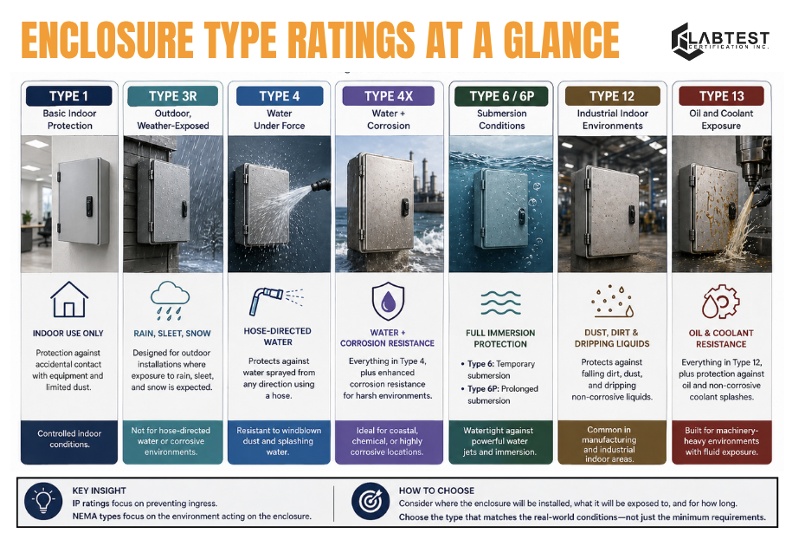
What Each Type Represents
Instead of a single scale, different Types represent different environmental conditions.
Each one reflects a specific use case.
Article content
Enclosure Type Ratings
Type 1 — Basic Indoor Protection
Designed for indoor use where the primary concern is accidental contact and limited exposure to dust.
👉 Not about harsh environments, just controlled indoor conditions.
Type 3R — Outdoor, Weather-Exposed
Built for rain, sleet, and snow.
👉 Outdoor use where weather exposure is expected, but not high-pressure or corrosive conditions.
Type 4 — Water Under Force
Designed to withstand hose-directed water.
👉 Not passive exposure, pressurized water conditions.
Type 4X — Water + Corrosion
Extends Type 4 by adding corrosion resistance.
👉 Used in coastal, chemical, or industrial environments.
Type 6 / 6P — Submersion Conditions
Designed for temporary (Type 6) or prolonged (Type 6P) submersion.
👉 Full immersion scenarios, not just splashing.
Type 12 — Industrial Indoor Environments
Protects against dust, dirt, and dripping non-corrosive liquids.
👉 Common in manufacturing and industrial facilities.
Type 13 — Oil and Coolant Exposure
Extends Type 12 by addressing oil and coolant splashes.
👉 Relevant for machinery-heavy environments.
Why This Matters More Over Time
Type Ratings are not just about how an enclosure performs during testing.
They reflect how it is expected to hold up through actual use.
Performance differences don’t usually appear immediately.
They emerge as the enclosure is:
- repeatedly exposed to its operating environment
- subjected to mechanical and installation-related stresses
- relied upon to maintain its construction and sealing over time
This is where construction, material selection, and assembly quality begin to matter more than initial performance.
Because long-term reliability is not defined at installation.
It is defined by how consistently the enclosure maintains its integrity in service.
What This Means for Manufacturers
Selecting an enclosure based only on ingress protection may not reflect how it will perform in its actual environment.
Because environments are not defined by a single condition.
They are defined by how conditions interact with materials, construction, and installation over time.
And that interaction ultimately determines performance.
Where LabTest Comes In
At LabTest Certification, enclosure evaluations include both evaluation against Type Rating requirements and Ingress Protection (IP) testing, depending on the product, application, and target market.
Testing is conducted in accordance with applicable standards to assess performance under defined environmental conditions.
This allows manufacturers to verify that their enclosures align with the environments they are intended for.
Takeaway
IP ratings answer whether anything gets inside.
Type Ratings define how an enclosure is constructed and how it is expected to perform in its intended environment.
They are often referred to as “NEMA ratings,” but in practice, they are Type designations defined within a standard not a certification issued by an organization.
And in many applications, performance is not defined by a single test.
It is defined by how the enclosure holds up over time, structurally, environmentally, and functionally.