

Invisible Sparks: The Hidden World of Static Electricity Testing
Invisible Sparks: The Hidden World of Static Electricity Testing
Everyone’s felt it, that tiny jolt when you touch a doorknob after walking across carpet. Annoying, yes. But in an industrial or medical environment, that same invisible discharge can mean a failed microprocessor, a frozen control system, or a spark in an explosive atmosphere.
Electrostatic Discharge (ESD) isn’t just a nuisance. It’s a transient electrical event lasting nanoseconds, with voltages high enough to puncture semiconductor junctions or ignite a gas-air mixture. And unlike most electrical phenomena, ESD happens without wiring, connectors, or intention. It’s electricity looking for a path home.
The Physics Behind the Snap
When two materials contact and separate, a technician lifting a plastic cover, a conveyor moving a label liner, even air flowing over a housing, electrons redistribute. The resulting voltage potential can exceed 30,000 volts, even though the actual charge involved is minuscule.
In a controlled environment, that energy can arc through insulation, damage sensitive ICs, or trigger EMI events detectable meters away. ESD is one of the few hazards that combines electrical, environmental, and human factors in one unpredictable event.
How Labs Recreate the Uncontrollable
Testing for ESD under IEC 61000-4-2 isn’t as simple as “zap and see what happens.” Each test simulates realistic discharge modes:
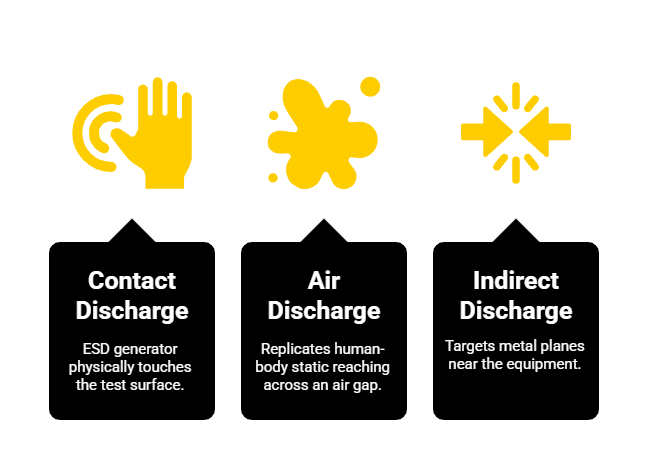
- Contact discharge, where the ESD generator physically touches the test surface to produce a controlled pulse.
- Air discharge: Replicating human-body static reaching across an air gap.
- Indirect discharge: Targeting metal planes near the equipment to measure radiated susceptibility.
Each pulse has a defined waveform, a sharp front edge peaking in less than a nanosecond, followed by exponential decay. Labs use precision instruments to measure how the device under test behaves: Does it reset? Does it latch up? Does it corrupt data but recover?
A single test can reveal design weaknesses no schematic shows like floating metalwork, ungrounded connectors, or poorly placed protective diodes.
When the Spark Hits the Wrong Place
One manufacturer of industrial control panels discovered intermittent shutdowns during field operation. Months of troubleshooting pointed nowhere until ESD testing reproduced the failure: a transient from a nearby operator panel induced a surge on a low-voltage signal line.
The cause wasn’t an obvious wiring flaw, it was the path of the spark itself. The panel’s enclosure, though grounded, had paint and insulation layers that created high-impedance joints. When static discharged, current diverted through signal ground, corrupting logic and halting the system.
A simple design adjustment, conductive gaskets at the seams and properly bonded panels eliminated the problem entirely.
That’s the hidden nature of ESD: it doesn’t announce itself with burn marks. It leaves behind silence, systems rebooting, sensors misreading, memory flipping bits you never notice until months later.
The Bigger Picture: Designing for Discharge
Modern electronics now integrate ESD protection at multiple levels:
- Component-level diodes and transient suppressors.
- PCB layout rules ensuring return paths and proper grounding.
- Shielding and bonding at enclosure seams.
- Environmental control: humidity, flooring, operator gear, in manufacturing areas.
But verification remains essential. Compliance to IEC 61000-4-2, ISO 10605 (automotive), or MIL-STD-883 (aerospace) isn’t just paperwork; it’s proof the design will survive the unpredictable, a spark from a human hand, a dry winter day, a field operator wearing the wrong gloves.
The Takeaway
ESD testing sits quietly in the corner of every compliance lab, a test that lasts seconds but speaks volumes about design discipline.
Because in today’s connected world, it’s not the lightning strike that stops systems, it’s the invisible spark no one saw.