

Electrical signage doesn’t follow a fixed product model.
Variations in size, enclosure type, electrical configuration, and installation requirements mean that even within the same project, designs can differ in meaningful ways.
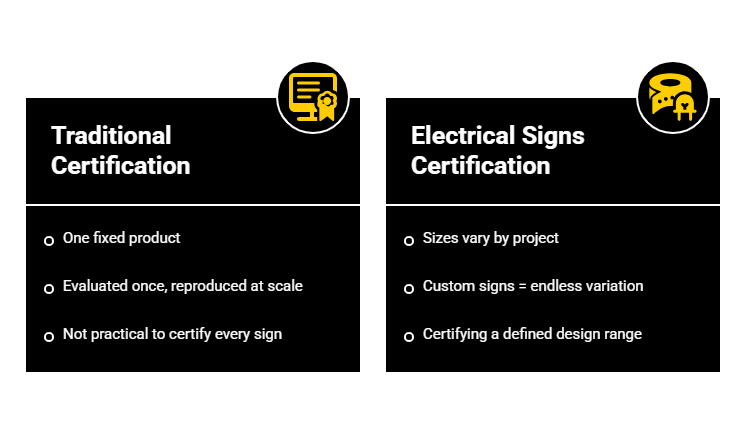
This creates a challenge in certification.
Because most certification frameworks are built to evaluate a single, defined product, not a range of designs that change from one build to the next.
Where Certification Assumptions Break Down
Traditional certification assumes one thing above all:
Consistency.
The same product, built the same way, evaluated once, and reproduced at scale.
Electrical signs don’t follow that model.
A single manufacturer may produce:
- different sizes of the same sign
- different enclosures depending on installation (indoor vs outdoor, NEMA ratings)
- different electrical configurations based on client requirements
Even when two signs look similar, their construction, ratings, or internal layout may differ.
Which raises a fundamental question:
What exactly are you certifying?
What Actually Gets Approved
The answer is not the individual sign.
It’s the design logic behind it.
The Sign Shop Program exists because certifying every individual sign is not practical. Instead, approval is based on a defined range, a controlled set of designs that share the same construction principles.
A manufacturer defines that range:
- types of signs
- electrical ratings
- enclosure types
- construction methods
From there, a representative sample is selected and evaluated.
That evaluation doesn’t just assess the unit.
It establishes the boundaries of what can be built within that approved design envelope.
The Hidden Constraint Most People Miss
This is where the program becomes more technical than it appears.
Approval is not flexible in the way many assume.
It is controlled.
Every sign produced under the program must remain within the defined range using:
- approved components
- consistent construction methods
- validated electrical configurations
Because the moment a design falls outside that envelope, it is no longer covered.
And that’s where most misunderstandings happen.
The variation is allowed.
But only within defined limits.
Why This Works And Why It Matters
Electrical signs are still required to meet strict safety standards.
In Canada, that means CSA C22.2 No. 207.
In the United States, UL 48.
These standards evaluate:
- electrical safety
- mechanical construction
- temperature performance
- strain relief
- protection against environmental exposure
The Sign Shop Program doesn’t bypass these requirements.
It applies them differently.
Instead of evaluating one fixed product, it evaluates whether a design system can consistently meet those requirements across multiple variations.
Where Responsibility Shifts
This is the part that changes everything.
Once an electrical sign is approved under the program, the manufacturer is authorized to apply the certification mark to products as long as they remain within the approved range.
That shifts part of the responsibility from the lab to the manufacturer.
Which means:
Compliance is no longer just something that happens once. It becomes something that must be maintained in production.
This is why periodic factory assessments exist not to re-test every sign, but to ensure that what is being built still aligns with what was approved.
The Real Insight
At its core, the Sign Shop Program is not about flexibility.
It is about control.
It allows variation but only within a framework that has already been evaluated. It allows customization but only within defined construction rules.
And it allows manufacturers to move faster but with the expectation that they understand exactly where the limits are.
Takeaway
Electrical signs don’t fit the traditional model of certification because they are not built as identical products.
The Sign Shop Program addresses this by approving a defined range of designs, rather than individual units using representative evaluation and controlled construction parameters.
At LabTest Certification, this approach ensures that custom-built signs can meet CSA C22.2 No. 207 and UL 48 requirements without sacrificing flexibility in manufacturing.
Because in sign manufacturing, compliance is not about repeating the same product.
It’s about consistently building within a system that has already been proven.